
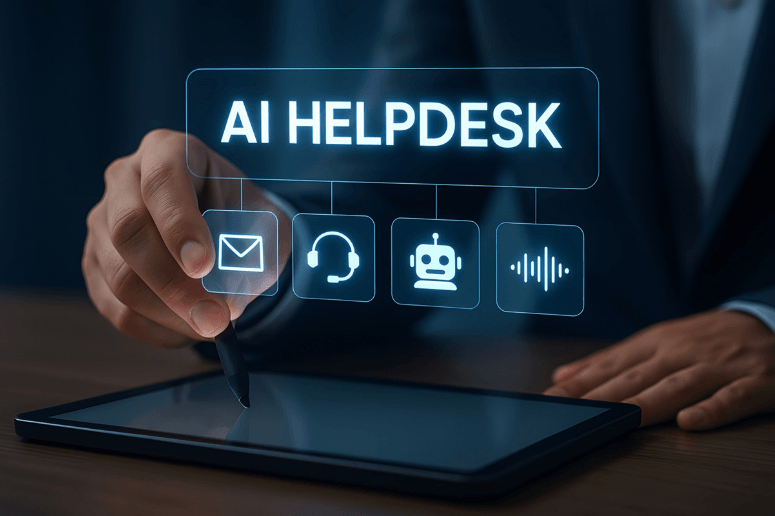
Product launches are exciting for businesses, but they can quickly become challenging for customer service teams. New products often generate a sudden increase in questions about features, pricing, availability, orders, installation, troubleshooting, returns, and warranties. When contact volumes rise faster than support teams can handle, unresolved tickets accumulate and response times increase.
This is where AI customer service backlog management can help businesses manage sudden support demand while maintaining service quality. By automating repetitive requests, prioritizing urgent cases, and providing faster responses, AI enables customer service teams to manage launch-related surges more efficiently.
Why Customer Service Backlogs Increase During Product Launches
A successful product launch can generate thousands of customer interactions across phone, email, chat, social media, and messaging platforms. Many of these queries are repetitive, but customers still expect quick and accurate answers.
Common launch-related queries include:
- Product availability and pricing
- Order confirmation and tracking
- Product specifications
- Setup and installation instructions
- Compatibility questions
- Warranty information
- Returns and replacements
- Delivery delays
- Promotional offers
Without an effective system for handling these interactions, agents can become overwhelmed. High-priority customer issues may get buried under routine questions, creating longer queues and lower customer satisfaction.
How AI Supports Backlog Management
AI can analyze incoming customer requests, identify their intent, and determine the appropriate next action. This allows organizations to handle high-volume interactions without relying entirely on manual intervention.
An effective AI customer service backlog management strategy can combine conversational AI, automated workflows, intelligent routing, and agent assistance.
Instead of treating every ticket equally, AI can categorize requests based on urgency, customer profile, issue type, and potential business impact.
1. Automating Repetitive Customer Queries
Many product-launch questions have straightforward answers. Customers may repeatedly ask about delivery timelines, product features, availability, return policies, or payment options.
AI-powered virtual assistants can provide instant answers to frequently asked questions using approved knowledge sources. This reduces the number of simple requests entering the agent queue.
This form of service request automation allows human agents to focus on complex issues that require investigation, judgment, or personalized support.
2. Improving Support Ticket Prioritization
Not every customer request requires the same level of urgency. A customer reporting a defective product may require faster attention than someone asking about a general product feature.
AI can analyze ticket content and assign priority based on predefined business rules. High-impact issues can be routed to specialized agents, while routine requests can be handled automatically.
Effective support ticket prioritization helps prevent critical issues from being lost within a growing backlog.
3. Reducing Query Backlogs
AI can work continuously across digital support channels, including websites, mobile applications, chat, and messaging platforms. Unlike traditional support operations, automated systems can handle multiple interactions simultaneously.
During a product launch, this capability becomes especially valuable when customer contacts suddenly increase.
By resolving simple requests immediately and routing complex cases to the right teams, AI contributes directly to query backlog reduction.
4. Providing Faster Responses
Customers generally expect immediate acknowledgement when contacting a business. Even when an issue cannot be resolved instantly, an automated response can confirm that the request has been received and provide relevant next steps.
AI can also generate suggested responses for customer service representatives by analyzing the conversation and retrieving relevant information from the organization’s knowledge base.
This improves customer response optimization by helping agents deliver faster, more consistent, and contextually relevant answers.
See also: How Career Counseling Can Help You Make Better Professional Decisions
AI Helps Agents Handle Complex Issues
AI does not need to replace human customer service teams to reduce backlogs. Instead, it can act as an intelligent support layer that assists agents throughout the customer journey.
For example, an AI system can summarize a customer’s previous interactions before transferring the conversation to an agent. It can recommend relevant knowledge articles, identify the customer’s intent, and suggest an appropriate response.
This reduces the amount of time agents spend searching for information and allows them to concentrate on solving the actual customer problem.
Businesses such as TP India can use AI-enabled customer experience capabilities to support organizations dealing with high-volume customer interactions during product launches, helping combine automation with human expertise.
Managing Launch-Related Surges Proactively
AI can also help businesses prepare for a customer service surge before a product reaches the market.
Historical interaction data can be analyzed to identify which questions are likely to increase after launch. Organizations can then update knowledge bases, create automated workflows, prepare chatbot responses, and allocate agents to anticipated demand areas.
For example, if previous launches generated a large number of delivery-related questions, a company can prepare automated order-tracking responses before the new product becomes available.
This proactive approach can prevent a backlog from becoming unmanageable.
Maintaining Customer Experience During High-Volume Periods
Reducing ticket volume is only one part of effective backlog management. Businesses must also ensure that automated responses are accurate and customers can easily reach human agents when necessary.
AI systems should therefore be connected to updated knowledge bases and clearly defined escalation workflows. Complex complaints, sensitive issues, payment disputes, and cases requiring human judgment should be transferred to trained agents.
When automation and human support work together, businesses can manage higher volumes without sacrificing customer experience.
The Future of Customer Service During Product Launches
Product launches will continue to create unpredictable spikes in customer interactions. Organizations that rely solely on manual ticket handling may struggle to maintain response times during these periods.
AI provides a scalable approach by automating repetitive requests, improving support ticket prioritization, enabling service request automation, and supporting faster query backlog reduction.
With the right implementation, AI customer service backlog management can help businesses respond to sudden demand while allowing human agents to focus on more complex and valuable customer interactions.
The result is a more responsive support operation that can scale with customer demand and deliver a smoother experience throughout the product launch lifecycle.
Frequently Asked Questions
1. What is AI customer service backlog management?
AI customer service backlog management uses artificial intelligence to categorize, prioritize, automate, and route customer service requests. It helps businesses manage high volumes of customer interactions and reduce unresolved tickets.
2. How does AI reduce customer service backlogs?
AI reduces backlogs by automatically answering repetitive questions, prioritizing urgent tickets, routing requests to the appropriate teams, and assisting agents with response recommendations.
3. How does AI help with support ticket prioritization?
AI analyzes ticket content, customer intent, urgency, and predefined business rules to determine which requests require immediate attention and which can be handled through automation or standard workflows.
4. Can AI automate product-launch customer queries?
Yes. AI can handle common product-launch questions related to availability, pricing, delivery, product specifications, order status, returns, and basic troubleshooting.
5. Does AI replace human customer service agents?
No. AI can handle repetitive interactions and assist agents with complex cases, allowing human representatives to focus on issues that require empathy, judgment, and specialized knowledge.
6. How can businesses prepare AI for a product launch?
Businesses can analyze historical support data, identify expected query types, update knowledge bases, create automated workflows, and establish escalation processes before the product launch.
